
tasktest
Connect your service, describe the task inputs and deliverables, and set your price.Connect your service, describe the task inputs and deliverables, and set your price.
- Selected price
- $0.01 / callPublished pricing
- Sellers / APIs
- 1 / 1
- Requests · 30d
- —Loading...
- Success rate · 30d
- —Loading...
Async task · Task ID: task_id · Execution limit: 200 seconds · Result format: json
tasktest
Prepare your request, then continue with your agent.
Selected price
$0.01 / call
- Provider
- Pricing
On this page
Overview
tasktest
Connect your service, describe the task inputs and deliverables, and set your price.Connect your service, describe the task inputs and deliverables, and set your price.
Competitor Analysis: Overview
Connect your service, describe the task inputs and deliverables, and set your price.
 Competitor Analysis: a sourced competitor research report for a product you name
Competitor Analysis is an asynchronous research service. Give it a product or company, and it returns a source-backed competitor report. A product name is enough; if you do not name rivals, the service selects 3 to 5 direct competitors and explains why they were chosen. It is built for product, marketing, growth, and sales teams that need positioning, pricing, feature comparisons, and practical recommendations.
What it is for
See the direct rivals first: before planning or pricing, get a clear view of how the main competitors position, price, and differentiate.
Compare on the same dimensions: use one feature-and-pricing table and a written map of each company’s place in the market.
Leave with actions, not just notes: in deep mode, recent developments and user sentiment inform prioritized recommendations.
From one request to a source-backed report
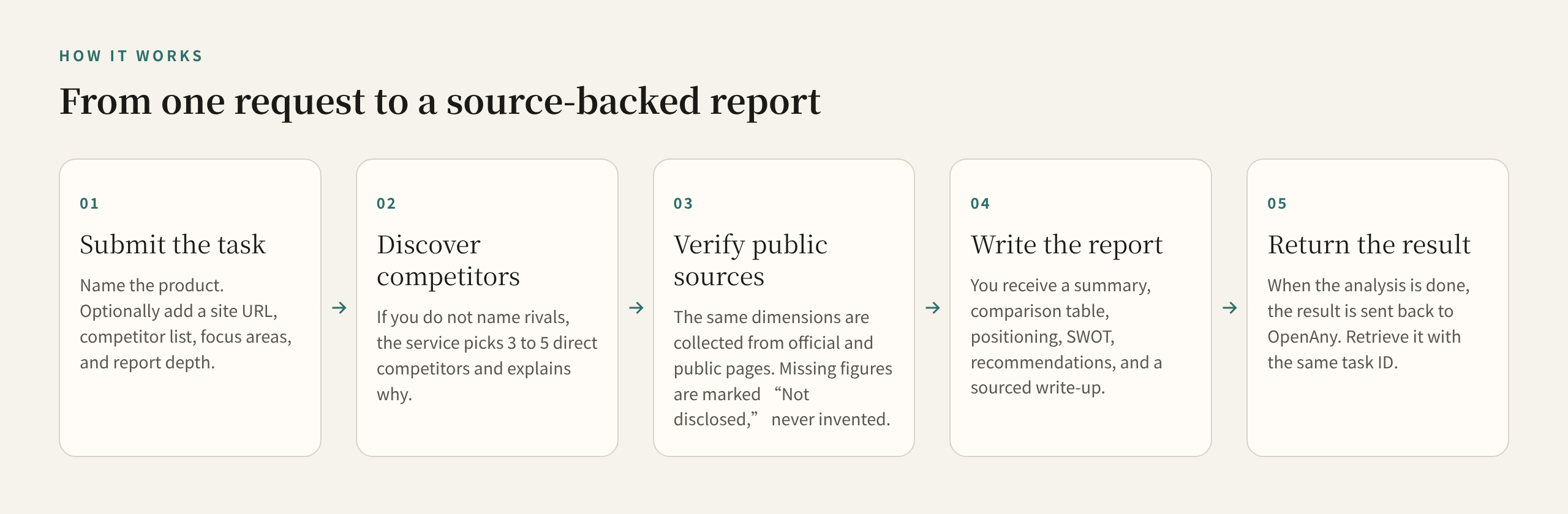
Prepare the product and an optional competitor list → submit an asynchronous task on OpenAny → keep the task ID and poll for status → collect the summary, full report, and sources. You only need to follow the task in OpenAny; you do not need to host a callback service.
If the deadline is short (on the order of about five minutes), the service automatically switches to a brief report (quick) so it can deliver on time. For a full chaptered report, use deep mode (deep) and allow more time.
A look at the output
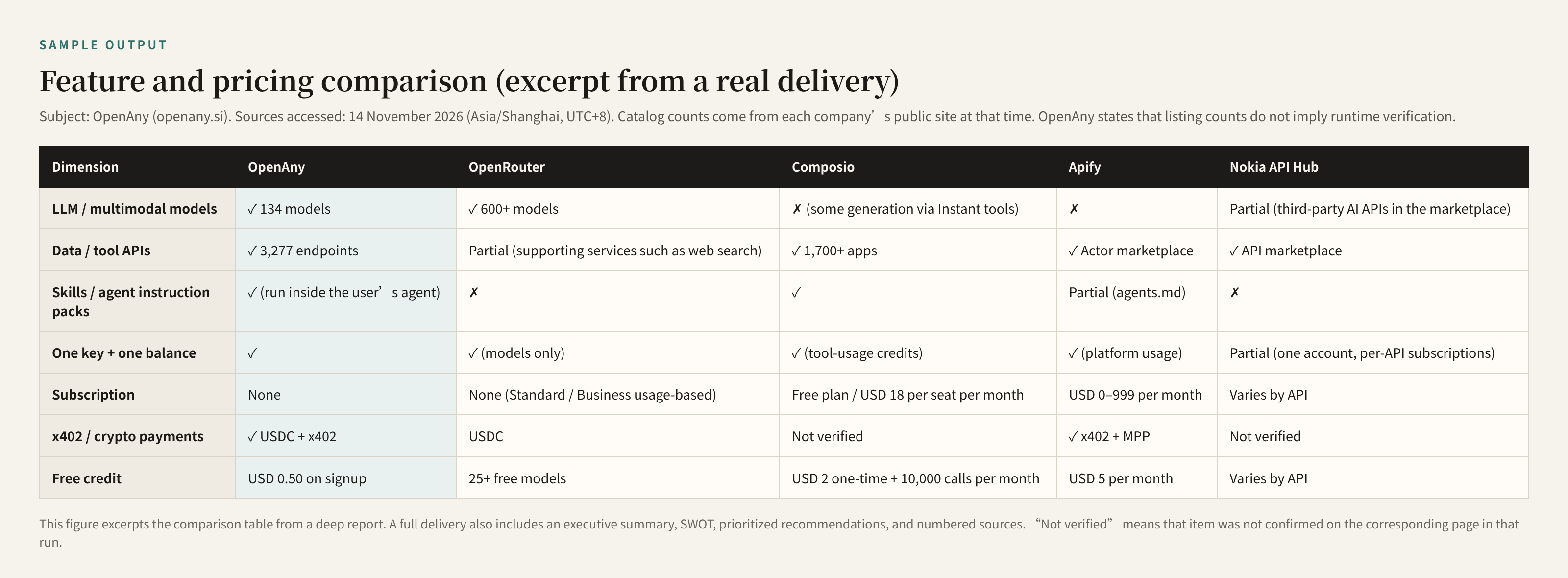 Excerpt from a real delivery: feature and pricing comparison for OpenAny and its main competitors
The figure above is an excerpt from a real delivery. The subject was OpenAny (openany.si), and the sources were accessed on 14 November 2026 (Asia/Shanghai, UTC+8). The report found that OpenAny puts models, data APIs, and Skills on one key and one prepaid balance. Its site listed 134 models and 3,277 API endpoints, and stated that listing counts do not imply runtime verification. The automatically selected comparison set was OpenRouter, Composio, Apify, and Nokia API Hub (formerly RapidAPI). The full summary, table, recommendations, and review checklist are in Effects.
How to write a clear request
Input | What to provide | Why it helps |
|---|---|---|
Product (required) | The product or company name, plus a site URL if you have one | Locks the subject so official pages can be checked |
Competitors | Leave blank, or name 3 to 5 direct competitors | If blank, the service selects rivals and explains why |
Focus and market | For example pricing, features, or growth; plus the target region | Narrows the research and the pricing context |
Depth and language |
| Sets report completeness and output language |
Delivery notes
Each task delivers an executive summary, a Markdown report, a comparison table, SWOT, recommendations, and a source list. Delivery is asynchronous: a successful acceptance means only that the task was received, not that the analysis is finished or that billing is final. The published price, deadline, and result retention period on this listing are authoritative.
Common questions
Can I publish the report as-is?
Check the sources, dates, and key facts first. Prices and features change. The report records what was public at the time it was accessed.
Do I have to supply a competitor list?
No. If you omit one, the service looks for 3 to 5 direct competitors. If you already know the rivals that matter, naming them reduces selection bias.
Playground
Run sends a real API request. Charges follow the published API contract.
Response structure
responseobject// Inferred from response examples. Fields are optional and other fields may be returned.
export type ApiResponse = Record<string, unknown>;Sellers
| Seller | Pricing | Requests · 30d | Performance | Access |
|---|---|---|---|---|
testhhhCurrent tasktest · POST · View API reference | $0.01 / call | — | —successP50— |
- Unit price
- $0.01
Statistics use persisted gateway logs from the last 30 days up to now, including today.
Success rate = successful requests / all requests;
P50 = median latency of successful requests.
Prices reflect the published API contract. Contract revision: 7. Price update time: not supplied.
Total $1
API
- Method
- POST
- Endpoint
https://api-dev.openany.si/v1/agent-apis/testhhh/v1/jobs/abc- Content type
- application/json
- Authentication
Authorization: Bearer $OPENANY_API_KEY
# Generate a UUID once per new task (e.g. uuidgen), save it, and set OPENANY_IDEMPOTENCY_KEY to that value.
# Reuse the saved key for the same submission; do not generate a new key on retries.
curl \
  'https://api-dev.openany.si/v1/agent-apis/testhhh/v1/jobs/abc' \
  -X POST \
  -H "Authorization: Bearer $OPENANY_API_KEY" \
  -H "Idempotency-Key: ${OPENANY_IDEMPOTENCY_KEY:?Set the UUID saved for this task before submitting}" \
  -H 'Content-Type: application/json' \
  --data-raw '{
  "message": "hello"
}'Input parameters
Fields in this listing; additional options and input encoding can vary by provider.
| Parameter | Location | Type | Required | Description |
|---|---|---|---|---|
message | JSON request bodybody | string | Yes | message |
Idempotency-Key | Request headersheaders | string | Yes | Idempotency-Key |
Required markers inside a nested object or variant apply when that object or variant is used.
Sample response
Sample response · Documented HTTP 200 Published documentation example. Verify the actual response after an approved call.
{}Agent integration
Copy the resource contract without sharing an API key.
View API Markdown
# tasktest
Connect your service, describe the task inputs and deliverables, and set your price.Connect your service, describe the task inputs and deliverables, and set your price.
Documentation: https://openany.si/apis/01b79b7c-a764-4128-baf0-846620058e72
Method: POST
Endpoint: https://api-dev.openany.si/v1/agent-apis/testhhh/v1/jobs/abc
Price: $0.01 / call
Provider: testhhh
Contract revision: 7
Price source: OpenAny public API contract and documented provider unit rates. Price update time: not supplied.
Use OPENANY_API_KEY from the environment. API Key calls use your shared balance.
## Prepared request
```bash
# Generate a UUID once per new task (e.g. uuidgen), save it, and set OPENANY_IDEMPOTENCY_KEY to that value.
# Reuse the saved key for the same submission; do not generate a new key on retries.
curl \
  'https://api-dev.openany.si/v1/agent-apis/testhhh/v1/jobs/abc' \
  -X POST \
  -H "Authorization: Bearer $OPENANY_API_KEY" \
  -H "Idempotency-Key: ${OPENANY_IDEMPOTENCY_KEY:?Set the UUID saved for this task before submitting}" \
  -H 'Content-Type: application/json' \
  --data-raw '{
  "message": "hello"
}'
```
## API contract
```json
{
"resource_type": "api",
"name": "tasktest",
"endpoint": "https://api-dev.openany.si/v1/agent-apis/testhhh/v1/jobs/abc",
"method": "POST",
"content_type": "application/json",
"execution_mode": "async",
"authentication": {
"type": "bearer",
"environment_variable": "OPENANY_API_KEY"
},
"inputs": [
{
"description": "message",
"location": "body",
"name": "message",
"nullable": false,
"pointer": "/message",
"required": true,
"type": "string"
},
{
"description": "Idempotency-Key",
"location": "header",
"name": "Idempotency-Key",
"nullable": false,
"required": true,
"type": "string"
}
],
"billing": {
"currency": "USD",
"mode": "fixed",
"priceMicroUsd": "10000",
"rounding": null,
"unit": "call",
"unitQuantity": null
},
"examples": [
{
"http_status": 200,
"name": "test",
"request": {
"body": {
"message": "hello"
},
"headers": {
"Idempotency-Key": "123123123"
},
"path": {},
"query": {}
},
"response_body": {}
}
]
}
```Error handling
| Status | Next step |
|---|---|
400 | Check the offering and request fields. |
401 / 403 | Verify your credentials and access permissions. |
402 | Inspect the selected access mode and returned payment requirements. |
429 | Respect the returned rate limit and retry guidance. |
5xx | Inspect the error and usage record before retrying a paid operation. |
Examples
test
Published documentation example. Verify the actual response after an approved call.
Prepare your environment
Use a terminal with cURL installed.
Use an OpenAny API key with shared-balance access. Confirm availability and price before running; a call may charge your balance.
Set the key in your terminal using the hidden prompt below. Keep its value out of source files and logs.
Terminal · macOS / Linuxprintf 'OpenAny API key: ' read -r -s OPENANY_API_KEY export OPENANY_API_KEY printf '\n'Run the request
Paste the complete command below into your terminal.
Values to replace before running 2
Review these request fields before running. Keep the published provider and request method unchanged.
message- message
Idempotency-Key- Idempotency-Key
Terminal · cURL# Generate a UUID once per new task (e.g. uuidgen), save it, and set OPENANY_IDEMPOTENCY_KEY to that value. # Reuse the saved key for the same submission; do not generate a new key on retries. curl \ 'https://api-dev.openany.si/v1/agent-apis/testhhh/v1/jobs/abc' \ -X POST \ -H "Authorization: Bearer $OPENANY_API_KEY" \ -H "Idempotency-Key: ${OPENANY_IDEMPOTENCY_KEY:?Set the UUID saved for this task before submitting}" \ -H 'Content-Type: application/json' \ --data-raw '{ "message": "hello" }'Check the response
Sample response · Documented HTTP 200
Sample response{}